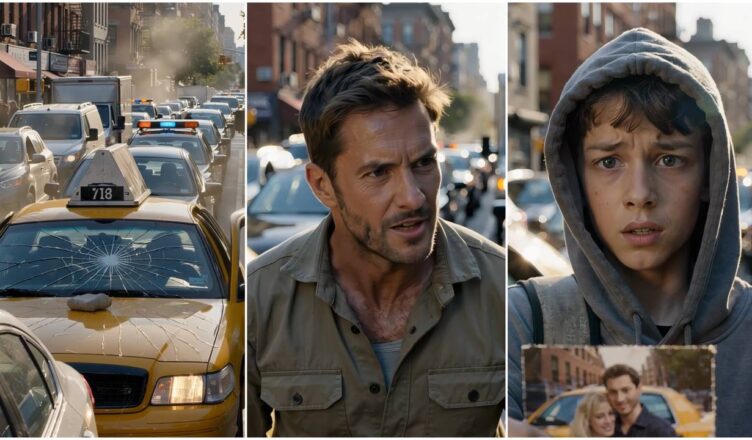
The traffic that afternoon felt built to break a man.
Cars idled bumper to bumper in the heat, horns ricocheting off brick storefronts while exhaust shimmered above the avenue. Elias had been driving since before dawn with bad coffee in his stomach and pain in his lower back. Every hour he told himself one more ride, then I’m done, and every hour he kept going because bills did not care how tired he was. Then something slammed into the windshield.
The crack raced across the glass with a sharp pop that sounded like a gunshot inside the cab. Elias cursed and hit the brakes. The taxi lurched sideways in its lane. Horns erupted behind him. He stared at the ruined windshield and felt the math arrive instantly: repairs, lost days, late rent.
He shoved open the door and climbed out already furious. Ten feet ahead stood a teenage boy in an oversized gray hoodie, thin as a rail, one hand still half-raised. Fifteen, maybe sixteen. Too old for this kind of stupidity. Too young for the desperation written all over his face. “Are you out of your mind?” Elias snapped. “Do you have any idea what that’s going to cost me?” The boy stumbled backward. “I’m sorry. I didn’t mean for it to hit—” “You didn’t mean for it to hit my windshield? Then what exactly did you think was going to happen?” But the boy did not run. That was the first thing that felt wrong. He was shaking, breathing too fast, eyes full of fear—but not the hard, defiant fear Elias expected. This looked older. Deeper. Then the boy whispered, “Dad?” Elias went still. “What did you say?” The boy swallowed. “You look exactly like him.” “Like who?” “My father.” He pulled a worn photograph from his backpack, folded so many times the creases had gone white. Elias took it automatically—and forgot how to breathe. It was him. Twenty years younger, leaning against a yellow cab outside a corner bodega, one arm around a dark-haired woman with laughter all through her face. Ana. For a moment the city disappeared. Elias looked back at the boy. Same dark lashes. Same nervous way of twisting his fingers together. Ana’s softness laid over Elias’s jaw. The rock slipped from his hand and hit the pavement. “Ana,” he said. The boy’s eyes filled. “So you knew her.” He had loved her badly and lost her worse. “What’s your name?” he asked. “Mateo.” “How old are you?” “Fifteen.” Fifteen years took Elias straight back to the last fight with Ana: the one-room apartment in Queens, the double shifts, the unpaid bills, and the frightened words he had thrown at her because fear always sounded like anger in his mouth. He had told her he could barely keep himself alive, let alone be somebody’s husband or father. She moved out the next week. He never saw her again. “Come on,” Elias said, voice rough. “Get in the cab.” Mateo flinched. “I’m not trying to scam you.” “I know. But I’m not doing this in the street.” He eased the taxi to the curb outside the diner where he stopped between fares and took Mateo inside. “Water for him,” Elias told the waitress. “And something fast.” Mateo slid into a booth and wrapped both hands around the glass when it came. “Start from the beginning,” Elias said. Mateo nodded once, like he had been waiting months to hear somebody say that. “My mom died last year,” he said. “Cancer. After the funeral I found the picture in a box with old bills and a bracelet. I asked my aunt who you were. She said your name was Elias, that you drove for Harbor City Taxi, and that my mother found out she was pregnant after she left you.” Elias stared at him. “She never told me that.” “My aunt said she wasn’t surprised.” Mateo kept his eyes on the table. “She said my mom believed you meant what you said. That you didn’t want a family, and she wasn’t going to beg somebody to stay.” “I said something like that once,” he admitted. “I was broke, angry at everything, and scared all the time. It was the stupidest thing I ever said.” Mateo looked up. “She never called you a bad man.” “How did you find me?” Mateo turned the photo over. On the back, in faded blue ink, Ana had written a date and the old company’s name. “I went to the garage three times,” he said. “At first nobody would tell me anything. Then an older dispatcher remembered you and said that if you were still driving, you probably still worked weekday afternoons around Midtown.” He drew a shaky breath. “I’d been looking for a week. I saw your medallion number today. I started yelling, but the traffic was too loud. I panicked.” “I wasn’t trying to hit your car,” Mateo said quickly. “I threw the rock at the pavement. I thought it might skip in front of you and make you stop. It bounced.” The shame in his voice finished off the last of Elias’s anger. “Why not knock on the window?” he asked. Mateo gave a small, miserable laugh. “Because what if I was wrong? Or what if I was right and you looked at me once and drove away?” Elias looked at the boy—the boy who might be his son, who had spent a week hunting through city traffic for a man he had every reason to fear—and felt something inside him crack wider than the windshield outside. “If there’s even a chance you’re mine,” he said, “I’m not driving away.” Mateo nodded, but belief did not come that fast. The food arrived. Mateo tried to hide how hungry he was and failed. Mateo slowed only when Elias pushed his own plate across the table. After the diner, Elias took the cab off the road and called his sister Rosa. He told her everything. There was a long silence. Then Rosa said, “Bring him here. Tonight. Tomorrow we do this right.” The next morning there were DNA swabs at a clinic, a meeting with a family attorney Rosa knew, and a call to child services because Mateo was still a minor with no stable guardian. After Ana died, he had been sleeping in his aunt’s crowded living room. Nobody had thrown him out exactly. Life had simply tightened around him until there was no room left. The results would take six days, the longest six days of Elias’s life. Mateo stayed with Rosa at first because Elias’s apartment over a laundromat was barely big enough for one man and his regrets. Rosa found an extra blanket. Elias bought groceries with money that should have gone to the windshield. Mateo apologized for everything—for the food, the couch, the broken glass, for taking up space. By the third day Elias understood that Mateo had been surviving like a stray: quietly, watchfully, ready to be blamed. On the fourth night, Elias took Mateo back to his apartment with takeout and sat with him on the fire escape. Mateo picked at his noodles for a while, then asked, “What was she like?” Elias knew at once he meant Ana. A smile came before he could stop it. “Too good for me, for starters.” “She laughed with her whole body,” Elias said. “She was terrible at lying. And she always believed life would open if you kept knocking.” Mateo stared out over the streetlights. “She used to sing when she cooked. Same song every time.” He hummed two uncertain bars. Elias closed his eyes. “She used to sing that in my cab just to annoy me.” For the first time since the diner, Mateo smiled without fear under it. The DNA results came the next morning. Probability of paternity: 99.99 percent. Rosa cried first. Mateo went completely still. Elias had thought he was ready, but the sight of those numbers knocked the air out of him. Fifteen years he had missed. Mateo looked up from the paper. “So it’s real.” Elias took a step toward him, then stopped. Blood was not the same thing as trust. “It’s real,” he said. “And I know I’m late in ways I can’t fix. But I am not leaving again.” Mateo’s face crumpled. This time, when Elias opened his arms, the boy did not hesitate. He came forward hard, like something inside him had been braced for years and had finally given out. “I’m here now,” Elias said into his hair, voice shaking. “It should have been sooner. I know that. But I’m here now.” Nothing turned simple after that. There were home visits, temporary guardianship papers, school meetings, and awkward days when Mateo seemed to hate being looked after because he had spent too long looking after himself. He hid granola bars in his backpack and woke at small noises. Elias learned fast that fatherhood was not made of speeches. It was made of repetition: showing up after school, keeping your word, knocking before opening a door, not taking silence personally. Some evenings Mateo talked. Some evenings he didn’t. On the hard ones they let baseball fill the room. On the better ones Mateo told him about school and some kid who was either a friend or an idiot depending on the day. Little by little, the apologies thinned out. Three months later, Elias finally replaced the windshield. The mechanic vacuumed the last bits of old safety glass from the dash while Mateo stood nearby in his school uniform. “You should’ve fixed it sooner,” Mateo said. Elias glanced over. “Had other things to pay for.” Mateo rolled his eyes, but there was warmth in it now. “Yeah. Me.” Elias smiled. “Yeah. You.” When the new glass caught the light, he thought of the day he had climbed out of the cab ready to scream at a stranger and instead found the missing shape of his own life standing there in an oversized hoodie, scared enough to throw a rock at the street just to be seen. That evening they drove home together through rush-hour traffic. Mateo sat in the front seat, telling Elias about school. The city was still loud. Bills still existed. None of that had changed. But when Elias looked through the new windshield and caught his son’s reflection beside him, the road ahead no longer felt like something he had to survive alone. Sometimes life didn’t knock politely. Sometimes it hit hard enough to make you stop. And sometimes that was the only way love finally found where it was supposed to go.