The Recording on the Tarmac
The heat above Van Nuys Airport bent the runway into a silver blur.
At noon, the private terminal was quiet in the expensive way—black SUVs under the awning, tinted glass holding back the sun, pilots moving through the glare, and a sleek white Gulfstream waiting outside with its stairs down.
Leona Price stepped out of the rear SUV before the driver reached her door.
She wore a white tailored pantsuit, a soft white blouse, dark sunglasses, and one thin gold watch. Her loose dark hair moved slightly in the hot wind. She looked calm, polished, untouchable.
Seattle first. Then Vancouver. Then a closed board meeting that would decide the future of Price Meridian Holdings.
Advertisements
Her chief of staff, Mara, followed several steps behind with two assistants and a stack of folders. Leona didn’t slow for anyone.
She crossed the private terminal, pushed through the glass doors, and stepped onto the blazing tarmac.
Everyone else had already boarded.
The flight attendant waited near the open jet door. The engines were quiet. The stairs gleamed white in the sun.
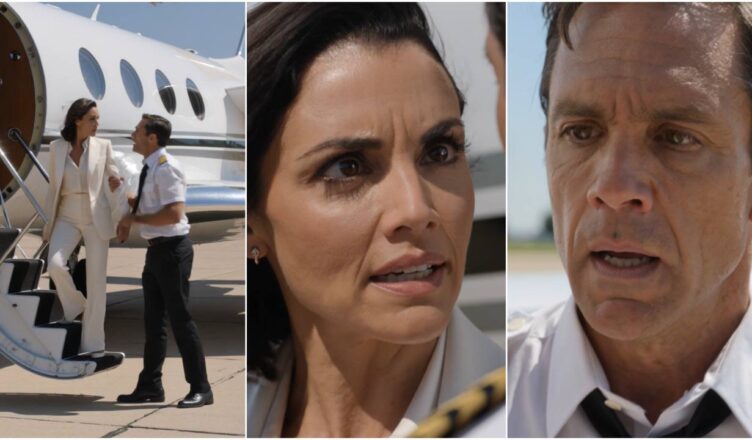
Leona was about to step onto the first stair when Captain Elias Rowe moved in from the side.
He looked terrible.
White pilot shirt. Captain’s stripes. Black tie loosened. Sweat on his face, collar, and underarms. His eyes were frightened, and he kept glancing toward the aircraft like the plane itself might hear him.
He caught Leona’s wrist only long enough to stop her.
Then he released it immediately and leaned closer, speaking in a low, urgent whisper.
“Mrs. Price…”
Leona turned sharply.
Her eyes narrowed behind the sunglasses. Hot wind lifted a strand of hair across her cheek.
She studied him for one beat and saw the panic he was trying to hide.
Elias swallowed.
“If you give me one million dollars, I can save your life.”
Leona went still.
Her expression hardened into cold disbelief.
“What the hell did you just say?”
Elias’s breathing was fast now. He looked once toward the cockpit window, then back to her.
“I’m going to play you a recording—and then you’ll understand everything.”
He reached into his pocket and pulled out his phone.
Leona did not move.
Behind her, Mara had stopped near the terminal doors, far enough away not to hear but close enough to sense something had gone wrong.
Leona lowered her voice.
“Captain Rowe, choose your next move very carefully.”
Elias nodded once, hands shaking as he unlocked the phone.
“I know.”
He tapped the screen.
For a second there was only static. Then a car engine. Then a man’s voice.
Grant Price.
Leona’s husband.
Calm. Warm. Almost bored.
“The aircraft leaves at twelve fifteen,” Grant said on the recording. “She’ll have her chief of staff and two assistants onboard. You dose the first officer before taxi. Nothing dramatic. Just enough to slow his reaction time.”
A second voice answered.
Elias.
“And the others?”
Grant gave a small laugh.
“What others?”
“The women traveling with her.”
“They work for her,” Grant said. “They knew the risks of staying close.”
Mara’s face changed from a distance. She could not hear the words, but she saw Leona’s posture.
Elias stopped the recording.
Leona’s face stayed controlled.
Only her hand changed. Her fingers tightened around the rail beside the jet stairs.
“Play the rest,” she said.
Elias hesitated.
“Play it.”
He pressed the screen again.
Grant’s voice returned.
“You get the aircraft over water. Low altitude. Control problem. Confusion in the cockpit. By the time anyone understands what happened, the plane is gone. Mechanical failure. Pilot error. Tragic headlines. My wife dies. Her staff dies. You disappear.”
Elias’s recorded voice was lower.
“You said this was just her.”
“I said you were being paid one million dollars,” Grant replied. “Don’t develop ethics after accepting the number.”
Leona stared at the phone.
The tarmac seemed too bright, too open, too silent.
Elias stopped the recording again.
No one spoke for several seconds.
Then Leona asked, “Why?”
His face tightened.
“My daughter.”
“How old?”
“Seven.”
“Name?”
“Clara.”
Leona looked toward the jet. “And my first officer?”
“Noah Bell.”
“You were going to drug him.”
Elias closed his eyes once.
“Yes.”
“Is he your friend?”
The answer came quietly.
“Yes.”
Leona looked back at him.
“So you accepted money to murder your friend, my staff, and me.”
Elias took the blow without defending himself.
“Yes.”
“And now you want me to pay you not to.”
“No.”
“That is exactly what you said.”
“I know,” he whispered. “But I’m not asking for cash. I’m asking you to keep my daughter alive. Pay the hospital directly. Put me in prison if you have to. I deserve it. But Clara doesn’t.”
Leona stared at him for a long moment.
He did not look clever. He did not look like a man running a con.
He looked ruined.
“Why didn’t you go to the FBI?” she asked.
“And say what? That I accepted payment for a murder I hadn’t committed yet? Grant would deny it. His lawyers would bury it. You’d board another plane tomorrow, and the next pilot he hired might not change his mind.”
Leona’s eyes moved toward the cockpit again.
Elias continued, voice low and rushed.
“I threw away Noah’s coffee. I haven’t touched the aircraft. The parachute Grant arranged is hidden in the rear equipment compartment. I have messages, account numbers, locations, every instruction he gave me.”
Mara was walking toward them now.
Leona lifted one hand without looking back.
Mara stopped.
Leona stepped closer to Elias, her voice colder than before.
“You will not receive one million dollars.”
His face fell.
Then she said, “Your daughter’s hospital will.”
Elias looked up.
“Full treatment,” Leona continued. “Paid directly. No cash in your pocket. No escape. You will give me the original recording, every message, every transfer, and a signed statement in front of my lawyer.”
He nodded quickly.
“Yes.”
“If you lie to me once, if you hold back one detail, if you run, I will make sure the rest of your life belongs to prosecutors.”
“I understand.”
“No,” Leona said. “You don’t. But you will.”
Mara reached them.
“What happened?”
Leona did not take her eyes off Elias.
“Our flight is grounded.”
Mara glanced at the jet. “Why?”
Leona finally turned.
“Maintenance issue. Hydraulic pressure anomaly. Enough to delay us. Not enough to look dramatic.”
Mara understood quickly. She always did.
Her face tightened. “Grant?”
“Yes.”
For the first time, Mara looked frightened.
Leona put her sunglasses back on.
“Phones away. No whispering. No panic. We are annoyed, not afraid.”
Then she looked at Elias.
“Ground my plane.”
He stepped back, wiped sweat from his face, and turned toward the stairs.
“Preflight hold,” he called up to the flight attendant. “Possible hydraulic issue. Nobody boards.”
Inside the cockpit, Noah Bell leaned toward the windshield, confused.
Elias climbed the stairs.
Ten minutes later, the Gulfstream was officially grounded.
Twenty minutes later, Leona sat in the back of her SUV and called her husband.
Grant answered on the second ring.
“Already in the air?”
Leona looked through the tinted window at the jet.
“No. Maintenance issue.”
A pause.
Small.
Almost nothing.
But she heard it.
“What kind of issue?”
“Hydraulics. The captain didn’t like the readings.”
“That’s unfortunate.”
“Yes.”
“Can they get another aircraft?”
“I told them not to. The board can wait.”
Another pause.
Tighter this time.
“You never let the board wait,” Grant said.
Leona leaned back against the leather seat.
“I don’t gamble with aircraft.”
Grant gave a soft laugh.
“No. I suppose you don’t.”
That night, Leona had dinner with him.
She sat across from Grant at their long marble table while he poured wine with the same hands that had arranged her death.
He asked about the failed flight.
She complained about maintenance delays.
He asked whether the pilot seemed nervous.
She said all pilots looked nervous when wealthy passengers were annoyed.
Grant smiled.
She smiled back.
For the first time in their marriage, Leona understood how easy it was to share a home with a stranger.
She did not sleep that night.
At 2:11 a.m., Elias sent the first encrypted folder.
Audio files.
Text messages.
Bank transfers.
Photos of the hidden parachute.
A screenshot of Grant’s first message:
I need a problem solved permanently.
By sunrise, Leona’s attorney had everything.
By noon, Clara Rowe’s hospital received payment authorization through an anonymous medical trust.
Elias sent two words.
Thank you.
Leona did not reply.
Gratitude was not forgiveness.
For four months, she became exactly the wife Grant expected.
She attended charity dinners beside him. She let him touch her waist for photographs. She listened while he spoke publicly about loyalty, legacy, and family.
Every smile bought her another day.
Every day bought her another document.
Through lawyers in Geneva and New York, Leona opened old ledgers, shell vendor records, and quiet trust amendments Grant thought she would never examine. She found payments to a woman named Elise Moreau, a former acquisition adviser and Grant’s mistress. She found company money routed through false consulting contracts. She found a private loan secured against assets Grant had no right to pledge.
Then Mara found the real reason Grant wanted Leona dead before the board meeting.
A revised corporate continuity agreement.
Hidden inside it was an emergency spousal provision. If Leona died before the merger vote, temporary control of her voting bloc would pass to Grant.
Not permanently.
Just long enough for him to move the company, sell the right pieces, and bury the rest.
Leona read the clause three times.
Then she closed the folder.
“He didn’t just want the money,” Mara said.
“No,” Leona replied. “He wanted the chair.”
The first strike came at a board dinner in October.
Grant arrived confident, one hand resting lightly on Leona’s back as they entered the private dining room. He wore a black suit and the relaxed expression of a man who believed he was still loved, or at least still useful.
Then he saw the lawyers.
The door closed behind him.
Leona stepped away from his hand and sat at the head of the table.
“Sit down, Grant.”
He looked around the room.
No one met his eyes.
That was when he understood the meeting had started long before he arrived.
Leona opened a black folder.
“Price Meridian Holdings has completed an internal review of unauthorized transfers, undisclosed related-party agreements, altered board materials, and fraudulent vendor payments.”
Grant smiled faintly.
“You’re accusing me of something?”
“No,” Leona said. “I’m documenting you.”
The screen behind her lit up.
Wire transfers.
Dates.
Approvals.
Grant’s initials.
Then Elise Moreau’s shell companies.
Then the hidden loan.
Then the continuity agreement.
One director leaned back as if the room had gone cold.
Grant looked toward general counsel.
“Say something.”
The counsel did.
“You should retain independent representation.”
That was the moment Grant started to sweat.
Leona placed the final document on the table.
“You will resign your board seat, surrender all voting proxies obtained under false pretenses, and sell your shares back to the company under the misconduct clause of your shareholder agreement.”
Grant’s smile disappeared.
“You can’t force me to sell.”
Mara placed another folder in front of him.
“You signed the clause yourself.”
Grant stared at his own signature.
His voice dropped. “You planned this.”
“You gave me time.”
Something ugly moved behind his eyes.
“You have no idea what I can do.”
The room went silent.
Leona held his stare.
“I know exactly what you can do.”
For one terrible second, she thought he understood how much she knew.
But he didn’t.
Men like Grant imagined ambition as a threat.
Not conscience.
Not a desperate pilot with a sick child.
The divorce filing went public two days later.
The company statement followed.
Grant Price resigned from all roles at Price Meridian Holdings “to avoid distraction during an internal review.”
The press called it a corporate split first.
Then a financial scandal.
Then a marital collapse.
Leona gave no interviews.
The money trail destroyed him cleanly. The affair humiliated him. The fraudulent transfers trapped him. The shareholder agreement finished him.
By December, Grant had sold his shares back to the company at a reduced valuation to settle civil claims.
By January, the divorce was final.
He received no ownership interest in Price Meridian.
No voting control.
No private jet.
No house.
No access to the accounts he had spent years imagining were almost his.
On the morning he signed the final papers, Grant sat across from Leona in a courthouse conference room, thinner than before, his expensive suit hanging differently on him.
He signed without looking at her.
For a while, neither spoke.
Then he said, “You don’t win just because I lose.”
Leona gathered her copy of the papers.
“No,” she said. “I win because I’m alive.”
His pen stopped moving.
For the first time, real fear entered his face.
He knew.
Not everything.
Enough.
“What did he tell you?” Grant whispered.
Leona put on her sunglasses.
“Enough.”
She left him sitting there with the pen still in his hand.
Outside, Mara waited beside the car.
“It’s done?” she asked.
“Yes.”
“Are you happy?”
Leona thought about it.
For months, she had moved like a machine: evidence, lawyers, meetings, silence.
Happiness felt like something from another country.
Then her phone vibrated.
An unknown number.
A photo appeared.
A little girl in a hospital hallway, thin but smiling, holding a nurse’s hand. Her hair was growing back in soft uneven patches. She wore pink socks and a yellow cardigan.
Below it was a message.
Clara walked twelve steps today. Doctors say the treatment is working. I know I don’t deserve peace, but she might get a future. — Elias
Leona stared at the photo for a long time.
Mara looked at her. “What is it?”
Leona turned the screen off.
“Good news.”
Three months later, Leona returned to Van Nuys Airport.
Same private terminal.
Same heat rising from the runway.
Different aircraft.
Different pilot.
No Grant.
She stepped out of the SUV before the driver reached her door. This time, she let him take the carry-on.
At the glass doors, she paused.
Across the terminal, near the coffee station, a little girl sat in a wheelchair with a knitted blanket over her knees. Elias Rowe stood behind her, thinner than before, no captain’s stripes, no uniform, both hands resting on the handles.
He did not approach.
He did not ask for forgiveness.
He only nodded once.
Clara lifted one hand and waved.
Leona looked at the child.
Then she waved back.
Small.
Private.
Enough.
Mara asked quietly, “Do you know them?”
Leona watched Elias turn the wheelchair toward the exit.
“No.”
Then, after a moment, she added, “But I’m glad they made it.”
Outside, the jet waited with its stairs down.
Leona crossed the tarmac in the bright California sun.
No one blocked her path.
At the bottom of the stairs, she stopped once and looked toward the runway.
The heat still bent the distance into silver.
This time, it looked less like danger.
More like a road.
Leona boarded the plane.
Behind her, the cabin door closed.
Ahead of her, the sky opened.