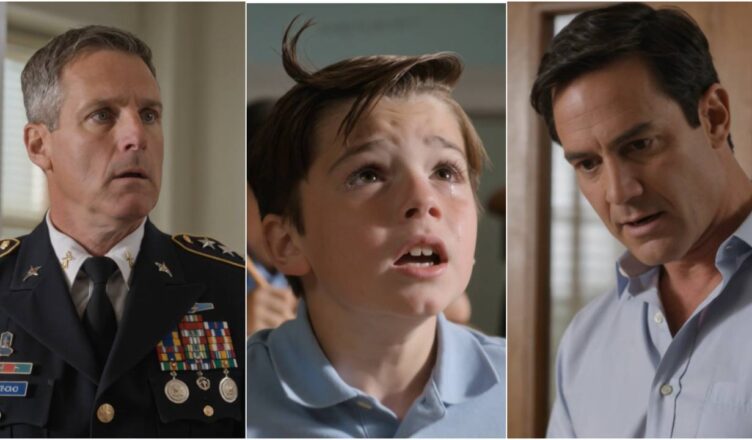
Late-morning light always entered Room 12 the same way—slanting through the tall windows in pale strips, catching the dust in the air, laying bright bars across scarred desks, open composition books, and the bent heads of eight-year-olds trying not to be noticed.
From the doorway, the classroom looked ordinary. A calendar with the days crossed off in red marker. A bulletin board crowded with misspelled thank-you notes. Laminated grammar charts curling at the corners. A hand-lettered sign above the whiteboard that said BE KIND, EVEN WHEN IT’S HARD.
Like many things in schools, it looked better on the wall than it did in practice.
Cedar Ridge Elementary sat on the edge of Fayetteville, North Carolina, inside the long military shadow of Fort Liberty. In that town, children learned the language of service early. They understood deployment before long division. They knew some fathers missed birthdays, some mothers missed Christmas mornings, and some promises had to wait until the Army was finished with them.
April was the Month of the Military Child, which meant purple paper chains in the hallways, stars cut from construction paper, and classroom projects about service, sacrifice, and people who helped others. In Room 12, the third graders had spent the week making posters about heroes: firefighters, nurses, EMTs, teachers, crossing guards.
Ethan Reed had chosen his father.
That, by itself, should have been the least remarkable thing in the room.
Mr. Nolan Mercer had been teaching long enough to know exactly how to control a class. He called himself strict, which was the polite word people used when they didn’t want to say cruel. He liked correction more than teaching, silence more than curiosity, obedience more than trust. He was thirty-nine, narrow-shouldered, clean-shaven, neatly dressed, with a tie always pulled too tight and a habit of removing his reading glasses right before saying something designed to sting.
He did not lose control by accident. He used it on purpose.
That morning, the children felt the charge in him before he spoke. A whisper at the back of the room died on its own. A boy stopped tugging at the zipper on his hoodie. A girl who had been smiling at her friend dropped her eyes to her worksheet.
Children know weather. Especially the kind that lives inside adults.
At the front of the room sat Ethan Reed.
Ethan was eight, brown-haired, serious-eyed, quiet in the way children become quiet when they’ve learned to measure a room before they trust it. He had a cowlick that never stayed down and a habit of rubbing the side of his thumb against the edge of his pencil when he was nervous. He wasn’t timid. He ran hard at recess. He climbed too high when no one was watching. But there was something careful in him, something braced.
His father was Major General Daniel Reed of the U.S. Army.
Almost no one at school knew that.
In the Reed family, rank stayed outside the house with the boots. Laura Reed had filled out school forms the same way every year: Daniel Reed — U.S. Army. Nothing more. Daniel did not want Ethan walking into classrooms carrying his father’s stars like a shield, and Ethan had been taught never to use them that way. At home, Daniel was not a general. He was Dad. The man who read chapter books in different voices when he was home, who grilled hamburgers on Sundays, who sometimes missed whole months and came back holding Ethan so tightly it felt like he was making up for distance with force.
Only Laura and Principal Vaughn knew Daniel was supposed to stop by the school just before lunch that day.
The visit had been arranged quietly two days earlier, after Fort Liberty asked whether a senior officer could speak to a few third-grade classes for Month of the Military Child. Daniel had agreed, but Laura had not told Ethan. Military families learned not to hand certainty to a child too early. Schedules changed. Briefings ran long. Planes were delayed. Something always moved at the last minute. Better a surprise than another disappointment.
So Ethan came to school that morning not knowing his father would walk through that door.
When his turn came to present, he stood with both hands around his poster board, holding it carefully so it would not bend. His letters were large and heavy, the way children wrote when they were trying very hard not to make a mistake.
My dad helps keep people safe.
He goes where people need him.
He is away sometimes, but he loves me every day.
He was not making a speech about politics or war or patriotism. He was talking about his father the only way an eight-year-old could.
The class was quiet at first.
Then Mercer leaned back in his chair and said, “Do you actually know what your father does, Ethan?”
The question landed wrong.
Ethan blinked. “He’s in the Army.”
“That’s not an answer.”
Ethan shifted his weight. “He goes where they send him.”
“And where is that?”
Ethan hesitated. “Sometimes he can’t tell me.”
A couple of children let out short, nervous laughs—not because they wanted to be cruel, but because children learn quickly when an adult has chosen someone as the safe target in the room.
Mercer let the sound hang there.
“Right,” he said. “That’s what adults tell children when they don’t want to explain things.”
Ethan’s face changed. Only a little. But enough.
“He’s not lying,” he said.
Mercer gave a small shrug. “You don’t know that.”
The room went still in a new way then. Not the stillness of attention. The stillness of danger.
Ethan finished because there was nothing else to do. He returned to his desk with burning ears and sat down without looking at anyone.
A decent teacher would have let the moment die.
Mr. Mercer was not a decent teacher.
An hour later, during writing block, the room had gone quiet except for the scratch of pencils and the rustle of paper. Mercer moved slowly between the rows with his hands clasped behind his back, pausing to correct posture, point out misspelled words, tap the side of a desk.
Then he stopped beside Ethan.
On Ethan’s journal page, written in careful pencil at the top of a paragraph, were the words:
My father is my hero.
Mercer picked up the notebook.
“Stand up,” he said.
Every pencil in the room stopped.
Ethan looked up. “What?”
“I said stand up.”
Ethan pushed back his chair and rose.
Mercer held up the journal page for the class to see. “We need to talk about this word,” he said. “Hero.”
No one spoke.
Mercer’s mouth tightened. “Children use words they don’t understand all the time. That is why adults are supposed to correct them.”
Ethan’s fingers curled at his sides. “Please give it back.”
Mercer ignored him.
“A hero,” he said, louder now, “is not just someone a child misses. A hero is not just someone in a uniform. A hero actually does something.”
Ethan swallowed hard. “He does.”
Mercer stepped closer.
“No,” he snapped. “You think he does.”
Then, in a voice sharp enough to make half the class flinch, he shouted, “Your father is a nobody! He’s never done a thing for this country!”
The words hit the room like something thrown.
A little girl in the back row gasped.
One boy actually lowered his head, as if not seeing it might somehow keep him out of it.
Ethan’s face went white, then red. His mouth opened, but for a second nothing came out. Tears rushed into his eyes so fast it looked as though the room itself had hurt him.
“That’s not true!” he cried, voice breaking. “My father is a hero! He is! He is!”
The last words came out through tears.
Mercer stared at him with the cold, satisfied look of a man who thought he was winning.
At the classroom door, reading specialist Ms. Lauren Monroe had just reached for the handle to collect a small intervention group. She heard the shout before she stepped in. Then she heard Ethan, crying.
She froze only a second.
Then she turned and moved quickly down the hall toward the front office.
The timing could not have been tighter if someone had written it.
At that exact moment, Principal Vaughn was in the office greeting the morning’s military guest from Fort Liberty.
Daniel Reed had come straight from a recognition ceremony on post, which was why he was still in dress uniform: dark green jacket immaculate, rows of medals and ribbons bright across his chest, combat badges above them, two silver stars of a major general visible on his shoulders. He had meant to stop in, speak to the children, and leave before the rest of the day swallowed him again.
Ms. Monroe reached the office breathless.
“You need to come now,” she said to Vaughn. Then she looked at Daniel, registered his name on the visitor log, and went pale. “It’s Ethan.”
Daniel went completely still.
“What about Ethan?”
Ms. Monroe swallowed. “His teacher is humiliating him in front of the class.”
That was all Daniel needed.
“Take me there,” he said.
They moved fast down the hallway—Vaughn in front, Daniel beside him, Ms. Monroe a pace behind. Office staff turned to look and then looked away again. Something in Daniel’s face made the whole corridor feel narrower.
Inside Room 12, Mercer still had Ethan’s journal in his hand.
“Crying doesn’t make it true,” he said. “Sit down.”
Ethan stood where he was, tears on his face, chest rising and falling too fast.
“My father is a hero,” he said again, smaller now, but no less certain. “He is.”
Then the door opened.
It did not slam. It did not need to.
The room looked up all at once.
Principal Vaughn stepped in first, but it was the man behind him who changed the air. Daniel Reed filled the doorway in Army dress uniform, medals bright across his chest, polished shoes dark against the tile, the two silver stars on his shoulders unmistakable even to children who didn’t yet know what all the decorations meant. He looked like the kind of man adults stood for without thinking.
Mercer turned—and visibly lost all color.
Daniel’s eyes went first to Ethan.
Nothing in his face moved when he saw the tears. That made it worse.
He crossed the room with measured steps, not hurried, not theatrical, the self-control of a man who had spent half his life mastering anger because other people’s safety depended on it.
Ethan stared at him through tears like he did not trust his own eyes.
“Dad,” he whispered.
Daniel stopped beside him and crouched to his level. “I’m here, buddy.”
That was all it took.
Ethan let out one broken breath and stepped toward him, and Daniel gathered him in immediately, one hand at the back of his head, one across his shoulders, holding him against a chest bright with medals and hard-earned metal that meant very little compared to the shaking child in his arms.
The room was silent.
Not school silent. Shock silent.
When Daniel finally straightened, he kept one hand on Ethan’s shoulder and turned to Mercer.
For a moment, Mercer actually seemed unable to speak.
Then, weakly, “General Reed, I—I didn’t realize—”
“That,” Daniel said, his voice calm enough to cut, “is the smallest part of what is wrong here.”
Mercer swallowed.
Daniel did not raise his voice. He did not need to.
“You shouted at an eight-year-old child,” he said. “You called his father a nobody. You told him his family meant nothing because service had kept his father away from home.”
Mercer opened his mouth. Closed it again.
Daniel’s hand stayed steady on Ethan’s shoulder.
“You do not get to use a child’s love for his parent as a weapon,” he said. “You do not get to shame him because he is proud of his family. And you do not get to decide what service to this country looks like from the front of a third-grade classroom.”
Mercer looked as though he wanted to disappear.
Principal Vaughn stepped forward then, face hard in a way the children had never seen before.
“Mr. Mercer,” he said, “put the journal on the desk and step into the hallway. Now.”
Mercer obeyed.
No one in the room spoke while he set Ethan’s notebook down with trembling fingers and walked out.
Only after the door shut behind him did the children seem to start breathing again.
Daniel looked around the room once.
He took in Sophie Bennett with her hand over her mouth. A boy in the second row staring down at his desk because he was ashamed he had laughed earlier. Two girls near the windows on the edge of tears themselves. Twenty children who had just seen the world stop making sense and then, just as suddenly, watched one adult put it back in order.
Daniel softened his expression before he spoke to them.
“No one should ever speak to one of your classmates that way,” he said. “Not here. Not anywhere.”
The class sat motionless.
Then Daniel looked back at Ethan.
“Let’s go take a walk,” he said quietly.
Ethan nodded.
They stepped out into the hallway together, Daniel’s hand still on the back of Ethan’s shoulder. The door closed behind them with a soft click, shutting off the classroom and its desks and its fluorescent lights and the moment that had split the morning in two.
Out in the corridor, the light felt cleaner.
Ethan made it three steps before the rest of the tears came loose again.
Daniel turned immediately and crouched in front of him.
“Hey,” he said, gentler now. “Look at me.”
Ethan tried. His face was crumpled with the kind of hurt children feel all the way through their bodies.
“He said you were nothing,” Ethan whispered. “He said you never did anything for this country.”
Daniel’s jaw tightened once, then released.
“Listen carefully,” he said. “That man was wrong.”
Ethan’s breathing shook.
Daniel put a steady hand at the back of his neck.
“My rank is not what makes me your father. These medals are not what make me worthy of you. Do you understand me?”
Ethan blinked up at him.
“What makes me your father,” Daniel said, “is that I love you, I come when you need me, and I would cross every mile they ever put between us to get back to you.”
Ethan’s mouth trembled.
“And yes,” Daniel added, quieter, “I have served this country. For a long time. But that is not the part I care about right now.”
He touched two fingers lightly to Ethan’s chest.
“What I care about is this: you were telling the truth in there. You were speaking from your heart. And no adult had the right to punish you for that.”
Ethan’s tears spilled over again. “You are my hero.”
Daniel closed his eyes for just a second, as if the words landed somewhere painful and sacred at once.
Then he pulled Ethan into him again.
For a few moments Ethan let himself be eight years old—small, shaken, relieved—and cried into the front of his father’s uniform while Daniel held him in the hallway outside Room 12.
A few feet away, Principal Vaughn stood in silence, giving them what privacy he could.
The rest would be handled by adults now. Properly.
Inside the classroom, children would remember the sound of that shout for a long time. But longer than that, they would remember the door opening. The medals. The stars. The stunned silence on Mr. Mercer’s face.
And Ethan, years later, would remember something even more clearly than that.
Not the teacher’s cruelty.
Not the humiliation.
Not even the shock of seeing his father standing there in full dress uniform like something out of a storybook the world had accidentally made real.
He would remember the first thing his father said when he saw him crying.
I’m here, buddy.
Because sometimes that is what rescues a child.
Not a speech.
Not a title.
Not the proof shining from a row of medals across a man’s chest.
Just this:
He came.