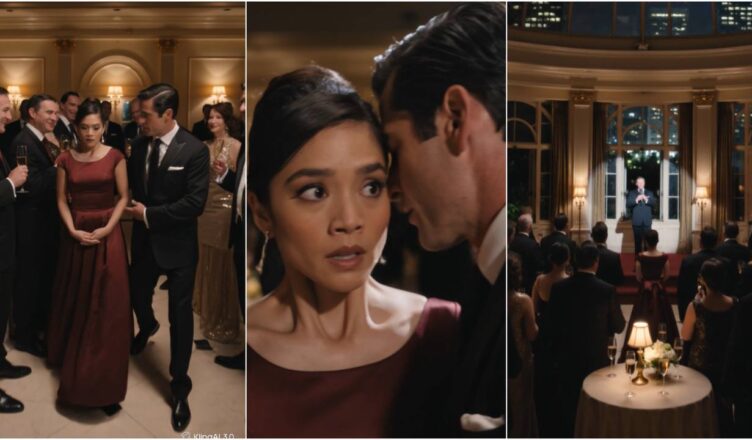
I had been working as a maintenance technician in Julian Blackwood’s penthouse for almost two years when he came looking for me in the service hallway.
That was strange enough on its own. Julian almost never stepped into the back corridors of the apartment. Those were for deliveries, repairs, and staff moving quietly through problems before they reached the polished front rooms. He belonged to the visible part of the penthouse—the library, the glass walls, the long rooms overlooking Manhattan.
He stood there in shirtsleeves with a black envelope in one hand.
Julian was a hard man to know, but not a hard man to read if you paid attention. He was exacting without being cruel, private without being rude, and so controlled he never touched people carelessly. Distance was the shape of his life.
“Elise,” he said.
“Something wrong?”
“Yes,” he said. “Though not with the building.”
Inside the envelope was a check for five thousand dollars.
I looked up at him. “What is this?”
“I want you to come with me tonight,” he said. “To the Blackwood Foundation gala.”
I almost laughed. “I fix your lights and unclog your sinks.”
“And you tell me when something is wrong even if everyone else insists it looks fine.” His gaze held mine. “Everybody at that gala wants something from me. You never have.”
I looked back at the check. Five thousand dollars was rent, bills, breathing room.
“It feels like you’re paying me to play a part.”
“No.” His answer came fast, almost sharp. “I’m compensating you for the pressure I’m asking you to stand in. People will stare. They’ll speculate. I won’t ask that of you for free.”
That mattered more than I wanted it to.
“Why me?” I asked.
“Because you tell the truth,” he said. “And because tonight I need one person beside me who isn’t there for strategy.”
I should have said no. Any sensible woman would have. But no one had ever asked me into a room like that because they believed I could stand in it as myself.
“I won’t know how to act,” I said.
His mouth moved, not quite a smile. “That may help.”
By six o’clock I was in a midnight-blue dress that somehow still felt like mine. His stylist had kept my makeup light and my hair simple. No one had tried to turn me into someone easier for his world to understand.
When I stepped into the foyer, Julian was waiting in a black tuxedo. He looked at me, and for the first time since I had known him, he forgot to speak.
“Well?” I asked.
“You still look like yourself,” he said.
It was the best compliment I had ever received.
In the elevator, he stood close enough to make me aware of him and far enough to make it clear the distance was still mine to close. That was Julian in every small thing—attention without intrusion.
“Before we go in,” he said, “the board has expectations for tonight.”
“Of course it does.”
“They expect a merger announcement. Robert Kahn expects public support. The press expects a woman they already recognize.”
“And instead they’re getting the maintenance tech.”
“Yes,” he said.
The ballroom sat under a glass ceiling with Manhattan lit behind it like a second city suspended in the dark. Gold light spilled across white linen and polished silver. Men with political smiles and women in expensive gowns turned as we entered.
I felt the pause immediately. The assessment. The polite kind of cruelty reserved for people who do not belong.
Julian noticed too. Without making a show of it, he moved half a step closer.
“You’re fine,” he murmured.
It should have sounded patronizing. It didn’t. It sounded like a promise.
He introduced me simply. “This is Elise Carter.” Not my employee. Not a guest from the staff. Just my name, offered with the same calm certainty he used for senators and donors. For the first ten minutes, I hated every second of it. Then I realized he had no intention of leaving me to fend for myself. He stayed with me. When questions sharpened, he answered them. When a man’s gaze lingered too long, Julian shifted by inches and blocked it without creating a scene.
Robert Kahn arrived smiling.
He was broad, silver-haired, perfectly tailored, the kind of man who treated rooms like assets. “Julian,” he said, shaking his hand. “You certainly gave everyone something to discuss.”
Then he turned to me. “And you must be Elise.”
“I must be,” I said.
His smile never moved above his mouth. “This is unexpected.”
“That has been the general response,” Julian said.
Kahn ignored that. “I assumed tonight would be more in line with the board’s plans.”
Julian lifted his glass. “That was your first mistake.”
A few people nearby pretended not to listen.
Kahn leaned slightly toward me. “These events can be overwhelming if one hasn’t grown up in them. Don’t feel pressured to say much.”
Julian went still beside me. Not angry. Controlled.
And suddenly I understood why he had brought me. Not because he thought I needed saving. Because he trusted me not to disappear.
So I smiled at Robert Kahn. “That’s a relief,” I said. “I was worried I’d be expected to admire all this on command.”
Someone behind him laughed. Kahn’s expression tightened, then smoothed over.
A few minutes later the lights dimmed for the foundation remarks.
I turned to Julian. “How bad is this about to get?”
His eyes held mine. “Trust me.”
Then he walked onto the stage.
“Every year,” he said into the microphone, “this room fills with people who care very much about being seen caring.”
Uneasy laughter moved through the crowd.
“Our foundation does good work. But institutions like ours develop habits. We reward polish. We confuse pedigree with judgment. We talk about service while taking advice only from people who have never had to repair anything with their own hands.”
The room went quiet.
“Tonight I was expected to make an announcement that would reassure investors, flatter the press, and preserve several very comfortable assumptions. Instead, I brought someone who understands what this room often forgets: when a system fails, appearances do not keep it standing. Competence does.”
His gaze found me.
“Elise Carter keeps my home running. She notices what other people miss. She says what is true before she says what is convenient. I invited her tonight because I am done pretending that worth arrives only in the right clothes, from the right schools, with the right introductions.”
Heat climbed into my face. I should have felt exposed. Instead I felt recognized with an accuracy that almost hurt.
He went on to announce a new workforce initiative—trade apprenticeships, repair grants for aging housing, paid technical training instead of the vanity partnership Kahn had been trying to force through the board. It was smart, practical, and impossible to dismiss as theater.
By the time he stepped off the stage, the room had already begun to recalculate. Donors were whispering. Reporters were moving.
“You could have told me,” I said when he reached me.
“Yes,” he said.
“That’s not much of an apology.”
“No.” His gaze stayed on mine. “Are you angry?”
I meant to be. Instead I was shaken by the fact that he had spoken about my work, my judgment, my ordinary life as if they carried weight in a room built to ignore people like me.
“You put me in the center of a room that usually steps around people like me,” I said.
“I know.”
“And?”
“And I thought you deserved to be seen in it before anyone tried to explain you away.”
That hit somewhere deep enough to leave me defenseless.
Robert Kahn returned before I could answer, his expression polished into something colder than irritation.
“This is reckless,” he said to Julian. “You embarrassed your board.”
Julian did not look at him right away. “No. I refused to let the board embarrass the foundation.”
Kahn shifted his attention to me. “Miss Carter, I hope you understand that attention in a room like this is temporary.”
Julian inhaled beside me, but I spoke first.
“My self-respect isn’t,” I said.
Kahn smiled that brittle smile rich men use when they have lost in public and intend to call it grace. “Enjoy your evening.”
When he left, Julian let out a slow breath. “You didn’t have to answer him.”
“I know.”
“Then why did you?”
Because I was tired of men like Robert Kahn speaking as if significance was something they handed out. Because Julian had trusted me in front of a room full of people who expected me to fold. Because somewhere between the service hallway and the ballroom, this had stopped being only his risk.
“Because I wanted to,” I said.
For the first time that night, Julian looked unguarded. Not for long. Just long enough for me to see the loneliness under all that discipline.
The reporters were getting closer now. Someone called his name. Someone else called mine.
Julian looked toward the side corridor, then back at me. “We can leave now. You don’t owe anyone here a single answer.”
I studied him. “What do you want?”
He didn’t dodge it.
“I want this to stop being about a room full of strangers,” he said quietly. “And I want to know whether you’re still here because of the check.”
I reached into my clutch, pulled it out, and folded it once.
“I haven’t decided what to do with the money,” I said. “But I know it isn’t why I stayed.”
Something softened in his face with enough force to make my chest ache.
He held out his hand.
Not for the cameras. Not to prove a point. Just an offer.
“I have spent most of my life surrounded by people,” he said, “and very little of it accompanied.”
I put my hand in his.
His fingers closed around mine with deliberate care, like he understood exactly how much could be ruined by taking too much too soon.
“Neither have I,” I said.
Beyond the glass, the city burned silver and gold. Reporters waited. Tomorrow would be a mess of headlines and opinions from people who had not stood where I was standing now.
But for the first time in my life, beside a man the city treated like something untouchable, I did not feel out of place.
I felt chosen.
Not as a symbol. Not as a scandal. Not as a rich man’s experiment in sincerity.
As a woman he had seen clearly before he ever asked me to see him in return.