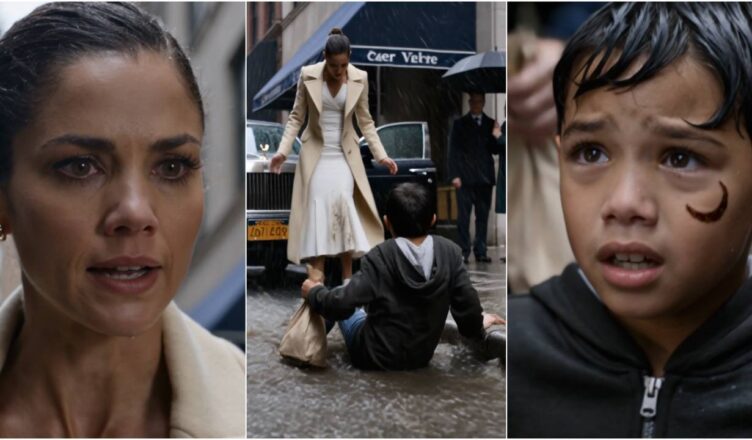
Rain hit Manhattan in cold silver sheets, turning the sidewalks into mirrors and the traffic into streaks of red and white. Outside Le Verre, one of those impossible restaurants where everyone looked expensive even when they weren’t, a white Rolls-Royce stopped at the curb.
Isabella Reed stepped out without hurrying.
At thirty-eight, she had mastered the art of moving as if the world owed her space. Her ivory dress was tailored to perfection beneath a long cream coat, her heels sharp against the pavement, her face composed in that distant, polished way people mistook for confidence. In magazines, they called her elegant. Powerful. Untouchable.
They had no idea how much of that was armor.
She was three steps from the glass doors when something small slammed into her hard enough to make her lose balance.
A boy.
He couldn’t have been older than nine.
He was soaked through, his dark hoodie torn at one sleeve, his jeans muddy at the knees. In both hands he clutched a greasy paper bag, and when he hit her, dirty rainwater splashed high across the front of her dress.
The stain spread instantly.
Gasps lifted from the people standing under umbrellas nearby.
The boy stumbled back, eyes wide with panic. “I’m sorry,” he blurted. “I’m sorry, ma’am. I didn’t mean to.”
Isabella looked down at the ruined silk, then back at him.
For one raw, ugly second, something mean and exhausted rose inside her.
“Do you have any idea what you just did?” she snapped.
The boy froze.
“I said I’m sorry.”
His voice shook—not like a spoiled child caught doing something wrong, but like a child who had learned early that adults could become dangerous with no warning at all.
Rainwater ran down his face. He lifted one trembling hand to brush wet hair off his forehead.
That was when Isabella saw it.
On his right cheek, just beneath the cheekbone, there was a small crescent-shaped birthmark.
Her breath caught so violently it hurt.
She knew that mark.
She had kissed that mark once, nine years ago, in a hospital room in Los Angeles, when a nurse placed her newborn son in her arms for less than five minutes.
“Oh my God,” she whispered.
The boy stared at her.
Her voice broke.
“Oh my God… I know that birthmark.”
He took a step back.
Before Isabella could say another word, a woman in a cheap raincoat hurried out from the crowd and grabbed the boy by the shoulder.
“Noah,” she said sharply. “Come on.”
The woman looked rough around the edges—stringy blond hair, tired face, fingers yellowed from cigarettes. She didn’t meet Isabella’s eyes for long, but in that one second, Isabella saw it: fear.
Not embarrassment.
Not irritation.
Fear.
A man waited at the curb half a block away beside an old gray van, engine running. When he saw Isabella looking, he turned his face away.
The woman dragged the boy toward him.
“Wait!” Isabella shouted.
The boy looked back once.
Just once.
Then the van door slammed, and they were gone.
Isabella stood in the rain, unmoving, as taxis sprayed water past her and the doorman called her name.
Nine years earlier, her son had disappeared from a private maternity wing less than twelve hours after he was born.
She had still been weak from an emergency C-section. The room smelled like antiseptic and lilies. Rain tapped softly at the hospital window. Someone in lavender scrubs had told her the baby needed to be taken for routine monitoring because of a brief breathing issue.
Isabella had kissed his cheek before they wheeled him out.
That tiny crescent near his cheekbone had been the last thing she had seen.
He never came back.
The hospital went into lockdown twenty-three minutes later.
A woman in medical scrubs had been caught on one hallway camera pushing a bassinet toward a service elevator during a shift change. Her face had been turned away. By the time security understood what they were seeing, she was gone.
No ransom note ever came.
No credible lead lasted.
The case devoured years of Isabella’s life—detectives, private investigators, reward money, psychics, false sightings, cruel scams, reporters camped outside her gate. At first she searched like a mother in shock. Then like a woman fighting for oxygen. Then like someone whose hope had been cut apart and stitched back together so many times it no longer looked human.
By the third year, people began gently suggesting she move on.
By the fifth, they stopped saying Liam’s name around her unless they had to.
Now, standing in the rain outside Le Verre, Isabella pulled out her phone with shaking hands and called the only person who had stayed beside her through every dead lead and broken promise.
David Miller answered on the second ring.
“David,” she said.
Something in her voice must have startled him. “What happened?”
“I saw him.”
A pause.
“What?”
“My son.” Her throat tightened. “I saw my son.”
David said nothing for two beats. Then, carefully, “Isabella…”
“He had the mark.” Her voice turned raw. “The birthmark on his cheek. David, I saw it. I know what I saw.”
He did not tell her she was mistaken. He had learned years ago never to do that.
“Tell me everything.”
She did.
Within the hour, David had obtained security footage from Le Verre, surrounding storefront cameras, and traffic cams farther down the block. By midnight, he had an image of the van and a partial plate.
By morning, he had names.
Thomas and Rebecca Cole.
Married. Both with minor fraud charges in two different states. Both had lived under other names before. Both moved frequently. They were currently renting a decaying one-bedroom apartment on the Lower East Side under a third-party sublease. There were no clean records showing the birth of any child named Noah Cole.
No hospital birth certificate.
No pediatric records before age two.
No consistent school enrollment.
Nothing that made sense.
By noon, David was in Isabella’s hotel suite with a folder in his hands and a grim look on his face.
“There’s more,” he said.
Rebecca Cole—under a different last name—had once worked for a temporary cleaning contractor that serviced St. Catherine’s Women’s Hospital in Los Angeles.
The same hospital where Isabella had given birth.
The room seemed to tilt.
David set the file down. “I’m calling LAPD Missing Persons and the FBI. If this is what it looks like, it stopped being a private matter the second that child crossed state lines.”
Isabella didn’t answer.
She was staring at a still frame from the restaurant camera.
The boy’s face.
That mark.
Those eyes.
Not memories of Liam—he had been too young to remember—but something worse and more powerful: the certainty of blood.
Police told her not to approach the family.
She ignored them the next day.
Wrapped in a dark coat and knit hat, Isabella stood across the street from the apartment building David had identified and watched.
At 4:17 p.m., the boy came out alone carrying a plastic grocery bag and a folded dollar bill.
He moved fast, shoulders slightly hunched, glancing back toward the building every few seconds. Not cautious in the ordinary way. Conditioned.
He came back twenty minutes later with cheap soup, bread, and cough medicine.
Thomas Cole was waiting in the doorway.
The man snatched the bag without thanks, looked inside, then grabbed the back of the boy’s neck hard enough to make him flinch.
Isabella took a step forward before David, beside her, caught her wrist.
“Not yet,” he murmured.
Her eyes burned.
“Not yet?” she whispered. “He’s hurting him.”
“And if you run across that street right now,” David said quietly, “they disappear before we have enough to get him back legally.”
She hated him for being right.
That night, law enforcement obtained permission to reopen the original infant abduction case as an active interstate kidnapping investigation. The next morning, an FBI victim specialist met Isabella in a sterile conference room and explained, gently but firmly, that birthmarks were not evidence.
DNA was.
Two days later, they got it.
The boy—Noah, to the people who had raised him—left a half-finished orange soda bottle on the stoop outside the apartment building. Agents recovered it after he went inside.
The sample was rushed.
Isabella gave blood the same day.
She did not sleep that night.
Or the next.
When David came to her suite with the results, he did not speak at first. He only handed her the paper.
Probability of maternity: 99.9987%.
Her legs gave out.
She sat down hard on the edge of the bed, one hand covering her mouth, the page shaking in the other.
Alive.
Her baby had lived.
He had grown up calling other people Mom and Dad. He had been sent into the rain for scraps of food while she spent nine years funding search teams and walking through memorial galas with a dead child inside her chest.
And outside a restaurant, over a stained dress, she had spoken to him like he was nothing.
She bent forward and sobbed so hard her ribs ached.
When the arrest warrants came, they came fast.
The FBI, NYPD, and Los Angeles detectives coordinated the takedown just after dawn three days later.
Isabella was not allowed inside the building, but she saw enough from the black SUV across the street.
Thomas Cole opened the door half-awake and froze when he saw the badges.
Rebecca screamed before anyone even touched her.
The boy appeared in the hallway behind them in pajama pants and a faded T-shirt, his hair messy, his eyes confused and terrified.
“Mom?” he said.
He was looking at Rebecca.
Not Isabella.
Something about that nearly broke her all over again.
Agents separated him before the shouting got worse. Rebecca tried to get to him, wild-eyed, screaming that they were making a mistake, that he was her son, that rich people were buying children now, that everyone was lying.
Then they found the box.
In the back of a hall closet, hidden behind old towels and a broken suitcase, agents recovered a sealed plastic bin. Inside it were nine years of secrets.
A hospital infant ID bracelet with the name BABY BOY REED.
A newspaper clipping about the abduction.
A faded photo of Rebecca in stolen hospital scrubs.
Forged birth documents.
Old burner phones.
And, wrapped in yellowed tissue paper, the blue knit cap Liam had been wearing the day he disappeared.
Thomas broke first.
During questioning, he admitted Rebecca had stolen the baby after suffering a stillbirth weeks earlier and spiraling into a psychiatric collapse nobody treated. He had helped her run. Helped her forge documents. Helped her move east. Helped her keep the lie alive for nine years because by then turning back would have meant prison and losing the child they had convinced themselves was theirs.
It did not save either of them.
They were charged with kidnapping, custodial interference, identity fraud, conspiracy, and child endangerment.
The public called it justice.
For Noah—for Liam—it felt like the end of the world.
He did not go running into Isabella’s arms.
He did not cry, “Mom,” and recognize her soul on sight.
He screamed for Rebecca until he was hoarse.
He kicked at the agents.
He begged them not to take him away.
And when a child trauma counselor tried to explain that the people who raised him had lied, he stared at her with such shattered disbelief that even the adults in the room had to look away.
He was placed in a secure pediatric transition program instead of going straight home with Isabella. The decision was brutal and correct. He needed medical evaluation, trauma support, legal protection, and time.
The first time Isabella was allowed to see him, he was sitting at a small table with a deck of cards in front of him, though he wasn’t playing with them.
He looked up when she walked in.
There was no recognition in his face.
Only wariness.
And hurt.
“You’re the lady from the restaurant,” he said.
The words landed harder than any accusation could have.
“Yes,” Isabella said softly.
He looked at the counselor, then back at her. “They said you’re my real mother.”
Her entire body seemed to tighten around her heart.
“I am.”
He said nothing for a long moment.
Then, quietly: “You yelled at me.”
Isabella sat down slowly across from him. “I know.”
“And you looked mad.”
“I was.”
His eyes darkened, confused more than angry. “Why?”
No answer would ever be enough.
“Because I was broken,” she said. “And because I didn’t know who you were. That doesn’t make it okay. It only makes it true.”
He looked down at the cards.
“Rebecca said rich people only pretend to care.”
The counselor started to speak, but Isabella lifted a hand gently.
“Maybe some do,” Isabella said. “But I’m here anyway.”
He finally looked at her again.
“I don’t remember you.”
The honesty of it hurt so badly she nearly lost her breath, but she nodded.
“I know.” Her voice trembled. “You were only a few hours old when they took you.”
His fingers tightened around one of the cards.
“So how do you know I’m yours?”
She slid a folder across the table.
Inside were the DNA results, the infant bracelet, and a photo from the hospital room taken the morning he was born. Isabella looked exhausted in it, pale and tearful, but smiling down at a newborn wrapped in a striped blanket. On his tiny cheek, just beneath the bone, was the crescent-shaped mark.
The boy stared at the picture.
He touched the photo very carefully.
“That’s me?”
“That’s you,” Isabella whispered.
He looked up at her, and for the first time something in his expression shifted—not trust, not yet, but the first crack in the wall.
Over the next weeks, Isabella came to every supervised visit.
Every single one.
She did not miss for business dinners or press calls or board meetings or because it hurt too much.
She brought books when he couldn’t sleep.
Soup when he was sick.
A sketch pad when she learned he drew when he was anxious.
She learned he hated closed doors, loud voices, and anyone standing suddenly behind him. She learned he always saved half his dessert for later because part of him still believed food could disappear. She learned he slept curled tight on one side of the bed, as if still making himself fit on a narrow mattress against a wall.
She never asked him to call her Mom.
Not once.
When he grew angry, she let him be angry.
When he cried for Rebecca at night, Isabella sat outside the room and cried silently too, where he couldn’t see her.
When he asked the same questions over and over—Did they ever love me? Did you really look for me? Why didn’t you find me sooner?—she answered every time.
“Yes, I believe they loved you in a damaged and selfish way.”
“Yes, I looked for you every day.”
“No, I don’t know why it took so long.”
And then, always:
“But I’m here now.”
The family court process took months.
Rebecca and Thomas remained in custody awaiting trial. Psychologists, federal attorneys, child advocates, and social workers all weighed in. Headlines kept feeding on the story. Comment sections tore Isabella apart for the restaurant video, then built her back up when the kidnapping details came out. She hated all of it.
Because while strangers debated whether she deserved sympathy, her son was relearning what safety meant one ordinary day at a time.
The first time he laughed around her, it happened by accident.
She had tried to make grilled cheese in the apartment where she was staying near the treatment center and burned one side black. When she looked at it and muttered, “Well, that’s tragic,” he snorted before he could stop himself.
The sound was small.
But real.
She turned to him.
He looked startled, almost guilty.
Then she smiled for the first time in a way that didn’t hurt.
Months later, when the judge granted Isabella full legal custody, Liam—Noah, still Noah in many ways—didn’t say much at the courthouse.
He stood close beside her in a navy sweater, one hand curled in the sleeve, his eyes moving over everything as if he still expected the floor to disappear beneath him.
In the car afterward, Isabella didn’t push.
She just said, “We can go anywhere you want. Back to the apartment. For pancakes. To the park. Home to Los Angeles. Wherever feels safest.”
He was quiet for so long she thought he might not answer.
Then he looked out the rain-streaked window and said, very softly, “What if home is different now?”
Isabella swallowed the ache in her throat.
“Then we make a new one,” she said.
He turned toward her.
Not all the way.
Just enough.
When they flew back to California two weeks later, she had already prepared a room for him—but not as a museum to the baby she lost. No untouched nursery. No frozen time capsule. The room had been designed with help from his therapist: warm light, shelves for books, dark curtains, no locks on the inside, and enough empty space for him to choose what belonged there.
On the first night, he stood in the doorway for a long time.
Then he walked in, set his backpack on the bed, and asked, “Can I paint one wall dark blue?”
Isabella smiled. “You can paint all four if you want.”
He didn’t smile back.
But he didn’t look frightened either.
That was enough.
Winter passed.
Then spring.
Bit by bit, the boy who had been Noah in survival started letting Liam exist beside him.
Not instead of.
Beside.
He began introducing himself at school as Liam Noah Reed.
He stopped hiding crackers in his backpack.
He started sleeping with the bedroom door halfway closed.
Sometimes, when he was sick or half-asleep, he reached for Isabella’s hand without thinking.
And on a gray afternoon in April, rain tapping softly against the kitchen windows, he sat at the table doing homework while Isabella made hot chocolate on the stove.
She set a mug beside him.
He looked up.
For half a second, he seemed not to realize what he was about to say.
Then it came out naturally, quietly, like something that had finally found where it belonged.
“Thanks, Mom.”
Isabella went completely still.
He froze too, as if startled by his own voice.
The room held its breath.
Then she turned to him, eyes filling, and said the only thing she could trust herself to say.
“You’re welcome, sweetheart.”
He looked down, embarrassed.
But he didn’t take it back.
Outside, rain slid down the glass in soft silver lines.
Inside, for the first time in nine years, Isabella Reed no longer felt like a mother speaking into an empty dark.
Her son was home.
And this time, no one was going to take him from her again.